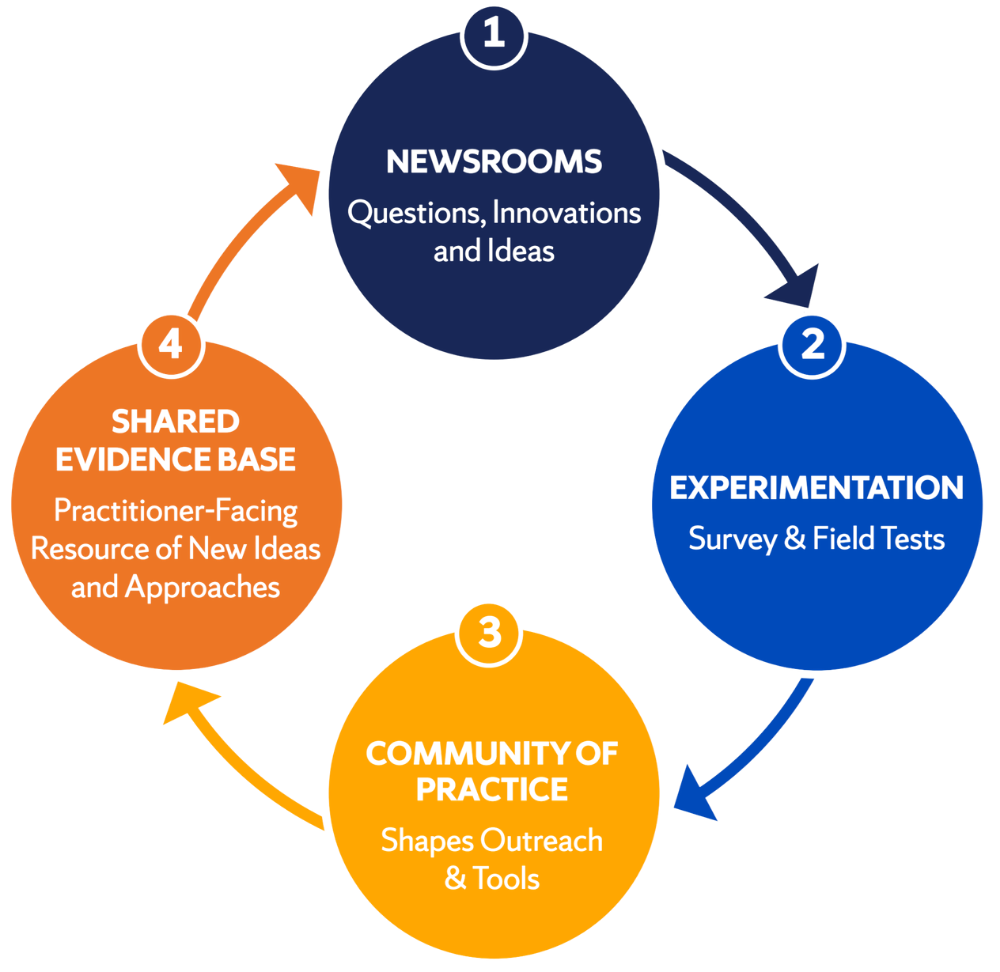
Research on local journalism doesn’t always answer the questions newsroom leaders are making decisions about every day. Local NExT Lab brings researchers and newsrooms together to identify what they want to learn, design experiments to test it and turn the findings into practical evidence newsrooms can use.
The Learning Cycle
What We’re Finding: Cohort 1
Four newsrooms. Four states. Ten experiments testing questions drawn from newsroom practice.
Mississippi Today
Investigative reporting lands better alongside community stories
Method: Readers were randomly shown story collections weighted toward community, investigative, or legislative content, then all rated the same investigative story.
Finding: Investigative reporting was rated more positively (specifically more accurate, credible, and relevant) when surrounded by community-focused stories, not other investigative stories.
Takeaway: Pairing your hardest-hitting work with local-identity content can improve readers’ perceptions of that civically valuable content.
Gulf States Newsroom
Branding wins follows, reporters’ faces win engagement
Method: Readers chose between social profile variants mixing outlet branding, reporter-led content, and post previews.
Finding: Established, issues-focused newsroom branding drove more follows, while a reporter’s face on camera drove more engagement with individual posts.
Takeaway: Factors that lead to a follow aren’t necessarily the tactics that get attention post-to-post.
Deep South Today
Video made the same story feel more important than a slideshow
Method: Arkansas adults saw identical story content about AI data centers in either video or slideshow format.
Finding: Those who saw the video rated the issue as significantly more important, both personally and relative to other state issues.
Takeaway: Format can shape how important an issue feels to audiences, not just whether they engage with the content.
Issue Media Group
Connection to place shaped response to solutions journalism
Method: Michigan adults read one of four versions of a pre-k policy story, varying framing (solutions vs. conventional) and geographic focus (local vs. state).
Finding: Readers with a stronger sense of local identity responded more positively to solutions-framed stories; readers with weaker local identity showed no such lift.
Takeaway: The same story approach can land differently depending on how connected the audience feels to the place they live.
Looking Ahead to Cohort 2
The Lab is growing. Cohort 1 began with four newsrooms serving communities across Michigan, Mississippi and the Gulf South. In Cohort 2, a new partnership with the American Journalism Project will expand the Lab to eight newsrooms across the country.
We’re also building on what we learned in year one by creating a stronger community of practice, bringing Cohort 1 partners into the next phase and creating more opportunities for participating newsrooms to learn from one another, replicate promising findings and contribute to a growing evidence base for the field.
The Local News Research Hub
The Lab also aims to make existing research easier to use. Built with Rebuild Local News, the Local News Research Hub is a searchable database of more than 160 academic studies on local news’ civic effects. Research is organized by topic so journalists, funders and policymakers can find relevant evidence without wading through academic journals. Since launching in May 2026, the Hub has drawn more than 2,000 active users.
FAQ
For the lab, an experiment starts with randomization: some participants are randomly assigned to see one version of content while others see another. Comparing their responses helps us isolate whether a change in framing, format, messenger or another element caused a difference in audience response. We initially test these questions through surveys, then help newsrooms consider how they can incorporate experimentation into their own practice.
Very little: 2-3 conversations and a willingness to learn. You don’t need to arrive with a research question, provide funding or dedicate staff to the project. We start with what you’re already doing, what you’re considering or what you’re curious about, and work together to identify something useful to test. The lab then designs, fields and analyzes the experiment and brings the findings back to your team to explore what they mean for your strategy.
No cost to participate. Just 2-3 conversations, and a commitment to learn.
Partner newsrooms see and discuss their findings first. From there, we share lessons across the cohort and with the broader field, building a shared evidence base that other newsrooms, researchers and funders can learn from. As partners continue experimenting, those findings can contribute to that evidence base too.
Each cohort lasts about 6-8 months. From getting to know you, to design and analysis and sharing, to helping you incorporate randomization into your practices, the partnership will hopefully endure beyond that — as long as you’re interested in continuing.
Yes, before any experiment is fielded we will have a conversation to make sure you’re on board with our design and what you want to measure. These tests are most valuable when we design them together and you can act on those findings afterwards.
You can opt out at any time.
Anonymized data may be shared with the broader scientific community through Dataverse, a repository maintained by Harvard. This will never include information from respondents’ identities.
Evidence about how specific editorial, engagement or distribution choices affect how audiences respond. Practical findings you can use to inform strategy. And a way to contribute what you learn to a broader evidence base for local journalism.
THANK YOU TO OUR FUNDERS